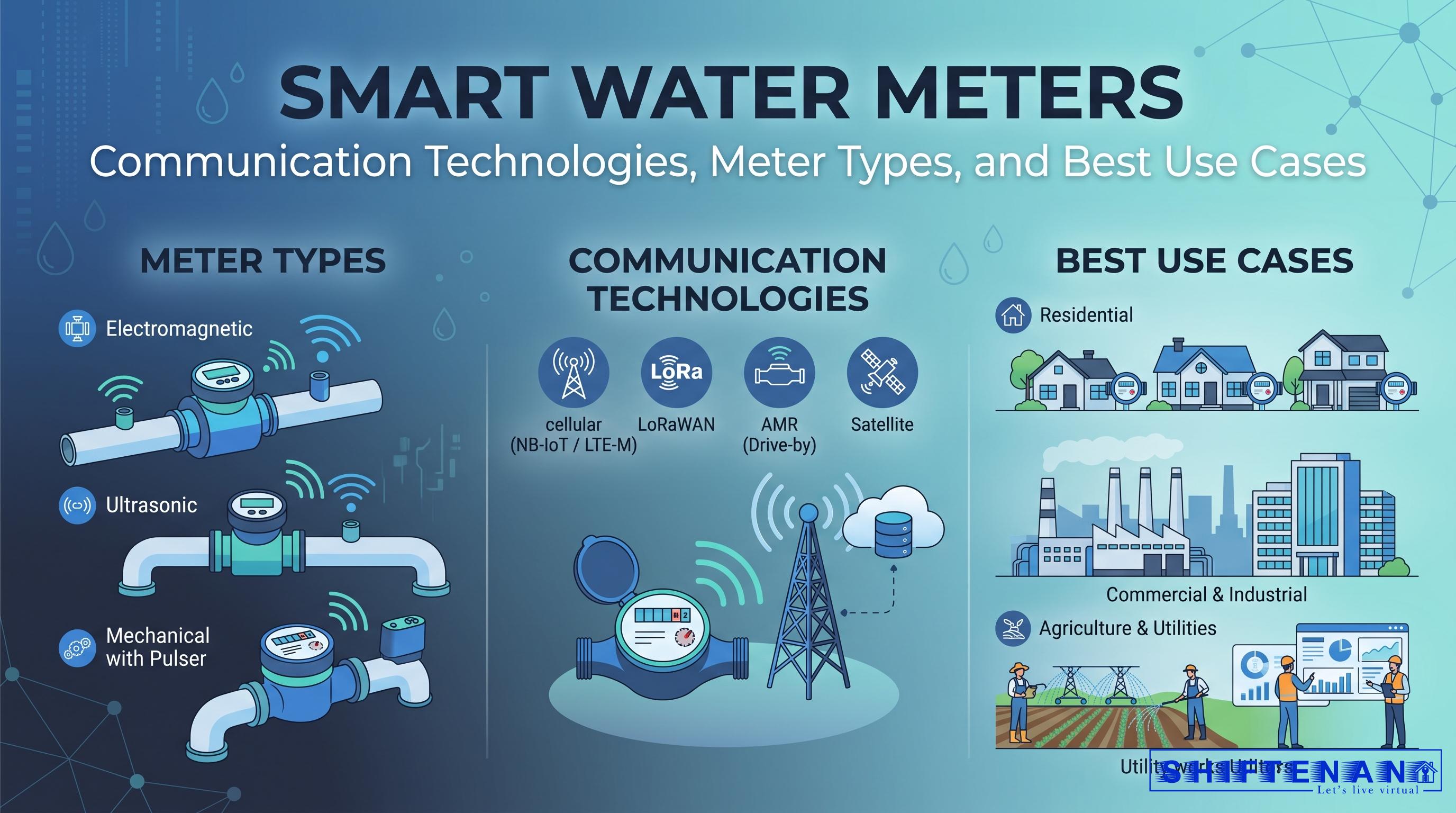
A practical guide to choosing the right meter and the right connectivity for the job.
Introduction
Traditional water metering relies on manual readings. That makes it slow to spot leaks, hard to see unusual usage as it happens, and prone to billing errors.
Smart water metering solves these problems by combining three things: a measuring device, a communication link, and a software platform. Together they let property owners, utilities, and property managers monitor consumption remotely, bill accurately, detect leaks early, and make better decisions about water use. The approach is especially valuable in apartments, gated communities, commercial buildings, and industrial sites, where consumption must be measured separately for each tenant or user.
Not all smart meters are alike, and two choices drive most outcomes:
- How the meter measures water (mechanical, ultrasonic, or electromagnetic).
- How the meter sends its data (for example LoRaWAN, NB-IoT, Wi-Fi, or a wired connection).
This guide explains each option, where it works best, and how to combine them.
1. At a Glance
Meter type
Main strength
Main trade-off
Typical fit
Mechanical
Low cost, proven design
Moving parts wear over time
Apartments, rentals, small commercial
Ultrasonic
Stable accuracy, low-flow detection
Higher upfront cost
Premium and large developments, leak-sensitive sites
Electromagnetic
Large-pipe, bulk measurement
Needs conductive water; often needs power
Utilities, industry, estate inlets
2. Meter Types by Measurement Technology
Start here: how a meter measures flow determines its accuracy, durability, cost, and the pipe sizes it suits.
2.1 Mechanical Smart Meters (Including Volumetric Designs)
How it works. Water moves a mechanical element, such as an impeller, turbine, or measuring chamber, and that motion is converted into a volume reading. A mechanical meter becomes "smart" when it has a pulse output, an electronic register, or a communication module for remote reading. Volumetric (positive-displacement) designs measure water in fixed chamber volumes and are often chosen for good low-flow performance.
Strengths
- Established, widely understood technology.
- Generally the lowest purchase price.
- Can be retrofitted with pulse-output or reading modules if the existing meters are compatible.
Limitations
- Moving parts can wear or be affected by deposits, so periodic maintenance may be needed.
- Low-flow accuracy varies by design and model.
Best for. Residential apartments, rental properties, small commercial buildings, and budget-sensitive deployments.
Example. A property manager with 100 rental apartments fits a mechanical meter in each unit and connects them to a remote-reading system. Consumption is recorded per tenant without staff visiting every apartment.
Selection tip. When comparing volumetric and turbine-based models, look at approved accuracy class, minimum flow rate, pressure loss, water-quality tolerance, and maintenance needs, not the technology name alone.
2.2 Ultrasonic Smart Meters
How it works. Ultrasonic signals are sent through the water, and the meter compares travel times with and against the flow to calculate flow rate and total volume.
Strengths
- No moving parts in the measurement path, so less wear and strong long-term stability.
- High accuracy across a wide flow range when correctly selected and installed.
- Many models detect very low flows, which helps with leaking cisterns and dripping taps.
- Often include displays, data logging, and alarms.
Limitations
- Higher initial cost than mechanical meters.
- Performance depends on the model, water conditions, and installation quality.
Best for. Modern apartment developments, premium residential properties, smart estates, and commercial buildings where accuracy and long-term monitoring matter.
Example. A developer building a 300-unit complex installs ultrasonic meters linked to a central platform. Managers can review consumption remotely, investigate unusual overnight usage, and catch leaks before they cause major damage.
Selection tip. Low-flow leak detection depends on the meter's minimum measurable flow and alarm features, so check these in the datasheet.
2.3 Electromagnetic Smart Meters
How it works. The meter uses electromagnetic induction to measure the velocity of an electrically conductive liquid, then derives flow rate and volume.
Strengths
- No moving measuring parts.
- Well suited to medium and large pipelines.
- Handles a wide flow range when correctly sized.
- Good for continuous monitoring of distribution systems.
Limitations
- Needs electrically conductive liquid and suitable installation conditions.
- May need mains or external power, depending on the model.
- Usually too costly for individual apartment metering.
Best for. Water utilities, bulk supply, industrial plants, large commercial facilities, and estate-level distribution.
Example. A gated community fits an electromagnetic meter on its main inlet and compares incoming volume with the combined readings of the apartment meters. A persistent gap can point to leakage, unauthorized use, meter inaccuracy, or reading-time differences. This "bulk versus sub-meter" comparison is a core tool for finding water losses.
3. Communication Technologies
Measuring water is only half the system. The meter must also deliver its data to a gateway, collector, or software platform. The right choice depends on the environment, distance, available infrastructure, battery-life needs, reporting frequency, and running cost.
3.1 LoRaWAN
A low-power, long-range network designed for devices that send small amounts of data. Meters transmit to a nearby gateway, which forwards the data through a network server to the management platform.
Advantages: long range under suitable conditions; very low power use, which suits battery meters; scales to large deployments; avoids a cellular subscription for every meter; good for periodic readings plus leak and tamper alerts.
Limitations: needs gateway coverage and proper network setup; basements, underground chambers, and reinforced concrete can weaken signals; regional radio regulations and capacity must be considered; the gateway itself needs an internet backhaul.
Best for. Large apartment blocks, gated communities, estates, campuses, and utility networks with many meters sharing one infrastructure.
Example. A property management company places a gateway at a central building and connects hundreds of compatible meters across an estate, after a radio coverage survey.
3.2 NB-IoT
A cellular IoT technology for devices that send small amounts of data at low power. Meters connect through a compatible mobile operator, so no private gateway is needed at the property.
Advantages: uses existing cellular infrastructure; designed for low-data-rate IoT; can reach difficult locations, depending on the network; simplifies deployment across scattered sites.
Limitations: depends on operator support and coverage (not every operator offers NB-IoT); SIM or connectivity fees may apply; battery life varies with signal strength and reporting frequency.
Best for. Utilities, dispersed properties, remote installations, and large rollouts where a private gateway network would be impractical.
3.3 LTE-M and 4G/5G
LTE-M is another cellular IoT option. Standard 4G or 5G modems suit cases that need more bandwidth or where no cellular IoT service exists.
Advantages: uses existing mobile networks; works for remote and multi-site deployments; conventional cellular can support frequent reporting and richer diagnostics.
Limitations: SIM or data costs; power use varies widely, and standard 4G/5G modems can drain small batteries unless carefully designed; long-term operator support for the chosen technology should be confirmed.
Best for. Utility networks, commercial properties, and multi-location systems that need dependable connectivity.
Rule of thumb. For battery-powered meters, NB-IoT or LTE-M is usually preferable to a conventional 4G/5G modem when supported.
3.4 Wi-Fi
Meters or meter gateways send readings over a local wireless network to an internet-connected platform.
Advantages: uses existing internet infrastructure; easy to integrate; supports frequent transmission where the network is stable.
Limitations: weak coverage in basements, meter cabinets, and underground chambers; frequent use shortens battery life; depends on local network reliability and security; managing credentials across many properties is cumbersome.
Best for. Individual houses, small buildings, plant rooms, and sites with reliable Wi-Fi and power.
Tip. Wi-Fi usually works better for a powered gateway than for hundreds of independent battery meters.
3.5 Bluetooth and Bluetooth Low Energy (BLE)
Short-range wireless communication between a meter and a phone, handheld reader, or nearby gateway.
Advantages: low power in suitable BLE designs; handy for configuration and maintenance; lets technicians read meters without opening sealed enclosures; no mobile subscription needed for local reading.
Limitations: short range; usually needs a person or nearby gateway to collect data; no continuous internet monitoring on its own.
Best for. Small rental properties, manual reading rounds, commissioning, and maintenance visits. It also works well as a service interface alongside NB-IoT or LoRaWAN.
3.6 Wired: M-Bus and Modbus
M-Bus was designed for utility meter reading (water, heat, gas). Modbus is common in industrial and building-management systems and may be used where compatible flow meters or gateways expose the data.
Advantages: dependable in well-designed installations; no reliance on radio coverage; good for centralized collection inside a building; integrates with building-management and industrial platforms.
Limitations: needs cabling and installation work; retrofitting existing buildings can be expensive; protocol, physical interface, and meter compatibility must be verified.
Best for. Hotels, hospitals, commercial buildings, industrial plants, and new developments where wiring can be built in during construction.
Example. A building collects readings from meters on every floor over M-Bus, then uses one internet-connected gateway to forward the data to the central platform.
3.7 Wireless M-Bus (W-M-Bus) and Other Metering Radios
A radio protocol built for utility meter reading. Other standards-based or proprietary radio systems may also be available, depending on manufacturer and market.
Advantages: purpose-built for meter reading; supports periodic readings from many meters; works with walk-by, drive-by, or fixed-network collection.
Limitations: requires compatible meters and receivers; frequency bands and modes vary by region; third-party platform integration depends on manufacturer support.
Best for. Utilities and property operators deploying a coordinated reading system on compatible radio equipment.
3.8 GSM, GPRS, and SMS (Legacy)
Older systems may send readings or alerts over GSM, GPRS, or SMS.
Advantages: familiar and still present in many installations; SMS can deliver simple alerts without continuous internet access.
Limitations: operators may retire legacy networks, so continued availability should not be assumed; SMS is a poor fit for frequent, structured telemetry.
Best for. Existing installations already built on compatible equipment, or specialized alerting where the operator confirms continued support. For new deployments, choose a technology based on confirmed local network support and expected service life.
4. Comparing Communication Technologies
Technology
Typical range
Power profile
Gateway needed?
Best application
LoRaWAN
Long, site-dependent
Low
Usually a LoRaWAN gateway
Estates and large buildings
NB-IoT
Cellular coverage area
Low (IoT design)
No private gateway
Distributed meters and utilities
LTE-M
Cellular coverage area
Low (IoT design)
No private gateway
Remote or multi-site IoT
4G/5G
Cellular coverage area
Device-dependent, often higher
No private gateway
Powered meters and data collectors
Wi-Fi
Local network range
Moderate to high for battery use
Wi-Fi access point
Houses and powered installations
Bluetooth LE
Short
Low
No, for local reading
Technician access and maintenance
Wired M-Bus
Cable-dependent
Interface-dependent
Usually a data collector
Hotels and large buildings
Modbus
Cable or network-dependent
Interface-dependent
Depends on architecture
Industrial and building systems
Wireless M-Bus
Local to site-wide
Usually low
Receiver or gateway
Utility meter-reading systems
These ranges and power profiles are qualitative, not guaranteed specifications. Real performance depends on hardware, installation, environment, network configuration, and reporting frequency.
5. Choosing the Right Combination
The measurement technology and the communication technology are chosen together. These common scenarios show typical pairings.
Scenario
Suggested meter
Suggested communication
Rental apartments on a budget
Mechanical
LoRaWAN or W-M-Bus (or NB-IoT where coverage is reliable)
Premium or large apartment development
Ultrasonic
LoRaWAN, or wired M-Bus if built in during construction
Estate bulk inlet plus unit sub-meters
Electromagnetic (inlet) plus mechanical or ultrasonic (units)
LoRaWAN or cellular, with a central platform comparing totals
Scattered properties across different locations
Mechanical or ultrasonic
NB-IoT or LTE-M
Hotel, hospital, or industrial plant
Ultrasonic or electromagnetic
Wired M-Bus or Modbus
Single house with reliable Wi-Fi
Mechanical
Wi-Fi or Bluetooth
6. Selection Checklist
Before committing to a solution, confirm the following:
- Purpose. Is the goal billing, leak detection, loss analysis, or all three?
- Scale and layout. How many meters, and are they in one site or many?
- Pipe size and flow range. Does the meter's minimum and maximum flow match actual usage?
- Accuracy and approvals. Does the model meet the required accuracy class and any local regulatory approvals?
- Power. Must the meter run on battery for years, or is mains power available?
- Site conditions. Are meters in basements, chambers, or reinforced buildings that weaken radio signals?
- Coverage and running costs. Is the chosen cellular network confirmed locally, and are SIM or gateway costs budgeted?
- Integration. Does the meter's protocol work with your billing or management software?
- Lifespan. Will the communication technology still be supported in ten years?
- Pilot first. Test a small batch on site before a full rollout, especially for radio coverage.
Conclusion
There is no single best smart water meter. Mechanical meters keep costs down for apartments and rentals. Ultrasonic meters add long-term accuracy and sensitive leak detection. Electromagnetic meters serve large pipes and bulk measurement. On the communication side, LoRaWAN suits dense estates, NB-IoT and LTE-M suit scattered sites, wired M-Bus suits purpose-built buildings, and Wi-Fi or Bluetooth suit small, simple installations.
The strongest systems match the meter to the flow and accuracy requirements, match the connectivity to the site and available infrastructure, and are validated with a pilot before scaling up.