Property management is changing.
For decades, managing a property meant rent books, spreadsheets, phone calls, physical inspections, paper leases, manual meter readings, and endless WhatsApp conversations between landlords, tenants, caretakers, and service providers.
PropTech changed some of this by bringing traditional property processes online. But the next evolution is bigger: the Property Operating System — or Property OS.
This is where ShifTenant is positioning itself.
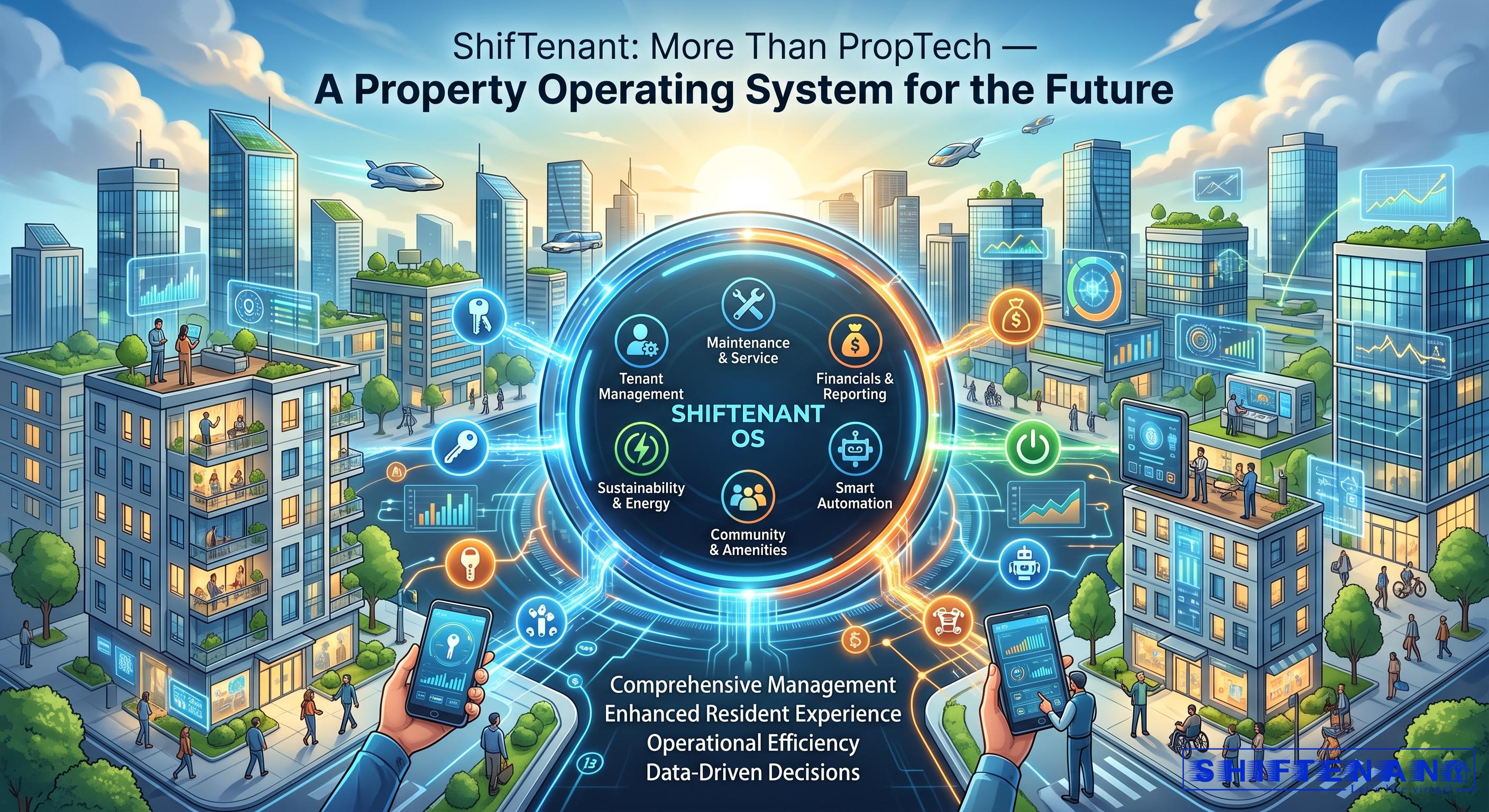
ShifTenant is not simply a property management application. It is being built as a connected operating layer for properties, bringing together traditional property management, financial technology, mobile applications, IoT, automation, data, and eventually AI to make properties easier to operate, monitor, and manage.
The global real estate industry is already moving toward this model. PwC describes the emerging Property OS as a combination of integrated data, AI agents, IoT, digital twins, and other technologies that can move property operations from reactive management toward predictive and autonomous operations.
ShifTenant is bringing that vision closer to the realities of property management in Africa.
From Property Management Software to a Property OS
Traditional property management software primarily digitizes existing processes.
You can manage tenants.
You can record rent.
You can issue invoices.
You can track leases.
You can send notifications.
These capabilities remain extremely important. In fact, they form the foundation of any modern property platform.
But a Property OS goes further.
Instead of having separate systems for rent, utilities, maintenance, tenant communication, property listings, and building infrastructure, the goal is to create an environment where these components work together and share information.
Imagine a tenant moving into an apartment.
Their lease is created digitally.
Their rent account is automatically established.
They receive access to the ShifTenant mobile experience.
Their utility meters are connected to the platform.
Their payments are recorded automatically.
Their utility consumption can be monitored.
A maintenance issue can be reported from their phone.
The property manager can see the status of the tenant, payments, utilities, maintenance and property operations from one place.
That is the difference between simply having property software and having a Property Operating System.
The Foundation: Traditional PropTech
ShifTenant starts with the fundamental problems property owners and managers deal with every day.
Property Management
Properties, units, tenants, leases and occupancy can be organized digitally instead of being scattered across spreadsheets, notebooks and multiple communication channels.
Rent and Payments
Property managers need to know what has been paid, what is outstanding and what is expected.
Digital payment and invoicing turn rent collection into a structured, traceable process rather than a manual exercise of checking messages and payment confirmations.
Digital Leases
Instead of relying entirely on physical documents, leases can become part of the tenant's digital property record.
This creates a more organized relationship between the property, landlord and tenant.
Tenant Communication
Communication is one of the biggest operational challenges in property management.
ShifTenant brings notifications, billing information, alerts and tenant interactions closer to the property management workflow.
Maintenance
Maintenance is not just about fixing a broken tap.
It involves reporting the problem, assigning the task, tracking progress, communicating with the tenant and keeping a record of what happened.
Bringing these processes into one platform creates operational visibility.
These are the PropTech foundations of ShifTenant.
But they are only the beginning.
Bringing the Physical Property Online with IoT
One of the biggest limitations of traditional property software is that software can only work with the information it receives.
If a property manager does not know what is happening inside the building, the software is essentially waiting for someone to provide the information.
IoT changes this.
Internet of Things technology allows physical devices such as smart water meters, energy meters, sensors and other connected equipment to communicate with software.
ShifTenant is already applying this approach to utility management.
Instead of relying entirely on someone to physically read a meter, smart utility infrastructure can send consumption information into the platform. This creates a connection between the physical property and its digital representation.
That opens the door to much more than automated billing.
A connected property can potentially tell its management system:
How much water is being consumed
How much electricity is being used
When consumption changes unexpectedly
When a utility balance is running low
When equipment may require attention
When an unusual pattern needs investigation
The property is no longer simply an asset being managed.
It becomes a source of real-time operational data.
The Mobile Property
Another important part of the Property OS concept is mobility.
Property management should not require someone to sit behind a desktop computer in an office.
The landlord may be travelling.
The property manager may be visiting another building.
The caretaker may be on-site.
The tenant may be at work.
A service provider may be on the other side of the city.
Everyone needs access to the information relevant to them.
This is where mobile applications become critical.
For Property Owners
Owners can gain visibility into their portfolio without needing to be physically present.
They can monitor property performance, payments, tenants and operations from wherever they are.
For Property Managers
Managers can handle day-to-day operations from their phones rather than constantly switching between spreadsheets, calls and messaging applications.
For Tenants
The property experience becomes self-service.
A tenant can access information, payments, invoices, utility information and other property services from their mobile device.
This is particularly important in markets such as Kenya, where mobile technology and digital payments are already deeply integrated into everyday life.
ShifTenant's own approach to smart utilities demonstrates this model: tenants can interact with their utility usage and payments through the mobile experience while property managers maintain portfolio-level visibility.
Connecting the People Around the Property
A property is not managed by the landlord alone.
There are tenants.
Property managers.
Caretakers.
Maintenance technicians.
Plumbers.
Electricians.
Cleaners.
Security teams.
Suppliers.
Accountants.
Service providers.
A true Property OS should therefore not only manage the building — it should connect the ecosystem around the building.
This is where ShifTenant can evolve beyond being a traditional landlord dashboard.
A maintenance request can become a work order.
A work order can be assigned.
The service provider can receive the task.
The work can be tracked.
The tenant can receive updates.
The property manager can monitor completion.
The cost can be recorded against the property.
One operational event can therefore flow through the entire system without requiring five different applications.
From Reactive to Predictive Property Management
Traditional property management is largely reactive.
Something breaks.
Someone reports it.
The property manager investigates.
A technician is called.
The problem is fixed.
But connected properties can change this model.
Imagine a smart meter detecting unusual water consumption overnight.
Instead of waiting for a tenant to discover a flooded apartment or receive an unexpectedly high bill, the system could identify the abnormal pattern and notify the relevant person.
Or imagine equipment whose performance gradually deteriorates.
Instead of waiting for a complete failure, data could indicate that something is behaving differently from normal.
This is where IoT, analytics and AI start working together.
The future is not simply:
"Something broke. Fix it."
It becomes:
"The system noticed something unusual. Investigate it before it becomes a problem."
Predictive maintenance and IoT-driven building intelligence are already becoming important areas of property technology.
Where AI Fits Into the Property OS
AI adds another layer to the system.
Today, property managers spend significant amounts of time looking for information, responding to repetitive questions, reviewing transactions, following up on tasks and identifying problems.
An AI-powered Property OS could become an operational assistant.
Instead of asking:
"Which tenants have outstanding balances?"
A manager could ask:
"Show me the properties with the highest outstanding rent and tell me which accounts need attention first."
Instead of manually reviewing maintenance records:
"Which buildings have had the most plumbing issues in the last six months?"
Instead of simply displaying utility data:
"Which units have unusual water consumption this week?"
The system moves from storing information to understanding information.
Eventually, AI agents could go even further by initiating workflows, escalating issues, communicating with stakeholders and coordinating tasks with limited human intervention.
This direction is consistent with the wider evolution of Property OS platforms, where AI agents, real-time data, APIs and connected physical infrastructure are being combined to automate increasingly complex property workflows.
One Platform, Many Layers
The ShifTenant Property OS vision can therefore be understood as several layers working together:
Property Management
Properties, units, tenants, leases and occupancy.
Financial Operations
Rent, invoices, payments, balances and financial records.
Tenant Experience
Mobile access, notifications, self-service and digital communication.
Utilities
Smart metering, consumption, billing and utility management.
IoT & Connected Infrastructure
Meters, sensors and physical property data.
Maintenance & Operations
Requests, work orders, service providers and operational records.
Data & Analytics
Turning property activity into useful insights.
AI & Automation
Helping property managers make decisions and automate repetitive workflows.
Integrations
Connecting payments, communication platforms, IoT infrastructure and other systems through APIs.
Together, these layers create something much more powerful than an isolated property management application.
They create an operating system for the property.
Why This Matters for Africa
The Property OS concept is particularly interesting for African markets.
Many property management processes are still fragmented.
A landlord may use one application for accounting, WhatsApp for tenant communication, spreadsheets for rent tracking, another platform for listings and physical processes for utilities and maintenance.
The challenge is not necessarily a lack of technology.
It is a lack of connection between technologies.
A Property OS can become the layer that connects these different activities.
For a landlord managing ten units, that means less administrative work.
For a property manager managing hundreds of units, it means scalability.
For tenants, it means a simpler and more transparent rental experience.
For property owners living abroad, it can provide visibility and control without requiring constant physical presence.
And for the property itself, it creates a digital operational record that becomes increasingly intelligent over time.
The Future of Property Management Is Connected
The next generation of property management will not simply be about replacing paper with software.
It will be about connecting the digital and physical worlds.
A property will have software.
The software will have data.
The data will come from people, transactions, mobile applications, sensors and connected devices.
AI will interpret that data.
Automation will turn insights into actions.
And property managers will increasingly move from manually coordinating every activity to supervising intelligent systems.
That is the direction ShifTenant is taking.
ShifTenant is not just trying to digitize property management. It is building toward a Property Operating System where people, properties, payments, utilities, IoT devices, mobile applications, data and AI work together.
The ultimate goal is simple:
Make property management easier.
Less paperwork.
Less chasing.
Less manual reporting.
Less uncertainty.
More visibility.
More automation.
More control.
And a better experience for everyone who interacts with a property.
The future of property management is not just smart buildings.
It is smart property operations.
And that is what a Property OS is designed to deliver.